

So you’re thinking about getting a water filter.
Maybe your tap water tastes fine, but you’re still uneasy.
Maybe you’ve heard words like “microplastics” and “heavy metals” one too many times.
Or maybe you just want better water for your family or office.
You’re not overthinking it.
In Singapore, water quality is generally safe, but the right filter still matters, depending on how you use water every day.
I’ll walk you through the types of water filters in Singapore, what each one actually does, and who they’re best for.
Plain talk. No hype.
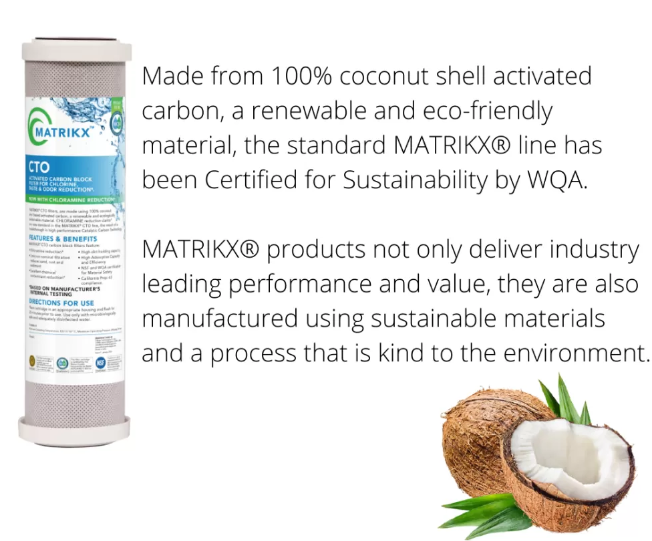
Activated Carbon Filters
This is the most common starting point.
An activated carbon filter works by adsorption, not absorption.
That means contaminants stick to the carbon surface instead of passing through.
These filters are great at improving taste and smell.
They commonly remove:
- Chlorine
- Chlorine by-products
- Volatile Organic Compounds (VOCs)
- Some pesticides
- General odours
They do not remove dissolved salts, viruses, or heavy metals in high concentrations.
Most countertop filters, pitchers, and basic water dispensers use carbon.
Best for homes that want better-tasting water without complex systems.
If you want a simple upgrade, start with an activated carbon filter
Sediment Filters
Sediment filters are the unsung heroes.
They don’t make water taste better.
They don’t kill bacteria.
What they do is protect everything else.
They remove physical particles like:
- Sand
- Rust
- Dirt
- Scale
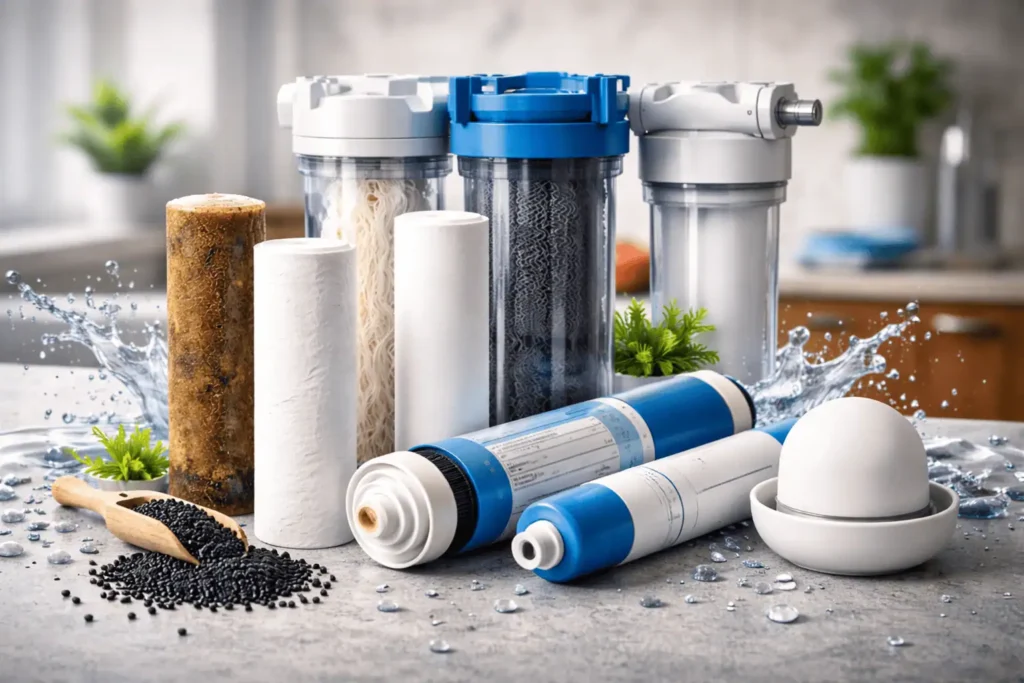
Common Sediment Filter Types
PP Sediment Filters
- Made from polypropylene
- Affordable and disposable
- Common in home systems
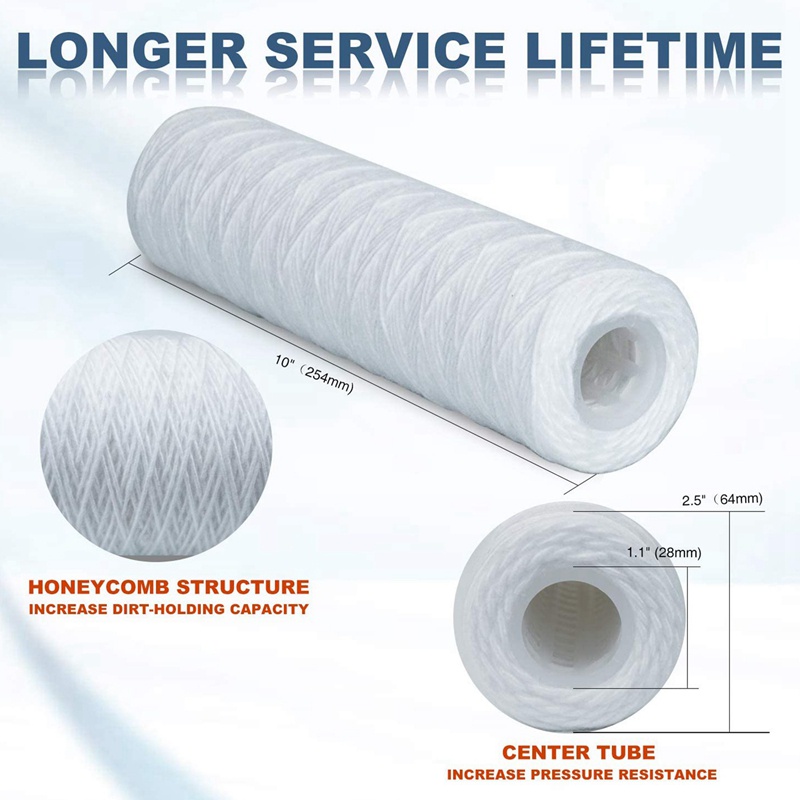
String Wound Yarn Filters
- Tightly wound fibres
- Better dirt-holding capacity
- Often used in higher-flow systems
Micron Ratings Explained
- 5 micron: general household protection
- 1 micron: finer filtration, better for sensitive systems
Sediment filters usually come first in a filtration setup.
They protect carbon filters, membranes, and valves from clogging.
Learn more about sediment filter types.
Types of Membrane Filters Commonly Used
Membrane filters work by size exclusion.
If a contaminant is bigger than the pore, it doesn’t pass.
Different membranes have different pore sizes.
That’s where UF, nano, and RO come in.
UF Membrane Filters
UF membrane filters (Ultra Filtration) usually have pore sizes around 0.01 micron.
They remove:
- Bacteria
- Cysts
- Sediment
- Some microorganisms
They do not remove dissolved salts or heavy metals.
Big advantage?
- No electricity required
- No water wastage
- Stable water pressure
UF membranes are popular in Singapore because tap water is already treated.
They act as a strong physical barrier without complexity.
Best for families who want reliable daily filtration.
Nano Membrane Filters
Nano membrane filters sit between UF and RO.
Typical pore size: 0.001 micron.
They remove:
- Bacteria
- Some viruses
- Heavy metals
- Reduced dissolved solids
Unlike RO, nano filtration:
- Keeps beneficial minerals
- Uses less water
- Works at lower pressure
Nano systems are a solid middle ground.
Good filtration without stripping water completely.
Ideal for homes that want balance, not extremes.
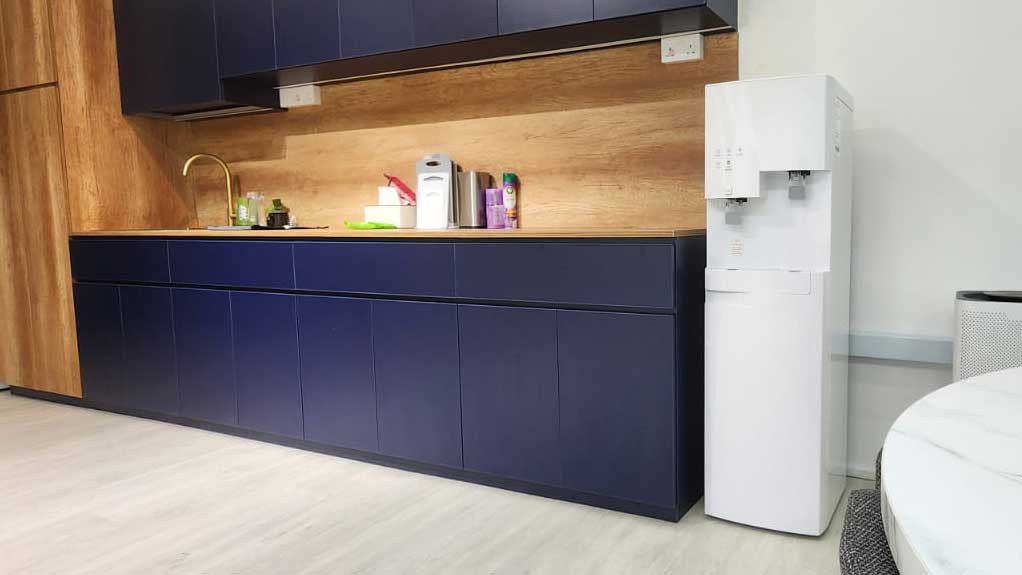
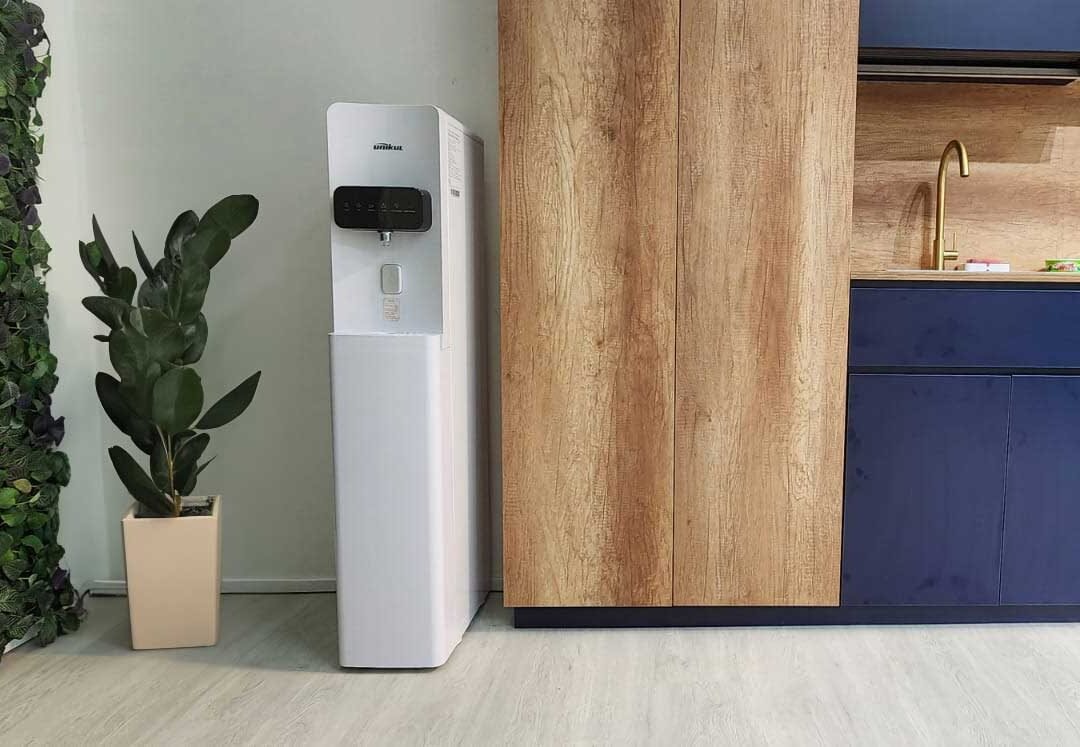
An example of a robust filtration system is in our Unikul Ultra Mini Tankless Water Purifier. It uses positively charged nano membrane and activated carbon filters developed by Toray Advanced Materials in Japan & S.Korea. The nano membrane is tested to remove 99.9% of E.Coli & norovirus.

Reverse Osmosis Filters
RO water filters are the most aggressive.
Pore size: around 0.0001 micron.
They remove:
- Heavy metals
- Fluoride
- Arsenic
- Nitrates
- Bacteria and viruses
They also remove most minerals.
That’s why RO systems often include a remineralisation stage.
Things to know before choosing RO:
- Requires electricity
- Produces wastewater
- Needs regular maintenance
RO is excellent when water quality is unknown or compromised.
Common in labs, medical settings, and older buildings.
Explore professional-grade RO water filters.
UV Filters
UV water filtration doesn’t filter anything out.
It sterilises.
Ultraviolet light disrupts DNA, making microorganisms harmless.
UV systems neutralise:
- E. coli
- Salmonella
- Giardia
- Viruses
UV must be paired with other filters.
Clear water is essential for UV to work properly.
Best used as a final safety layer.
Especially useful in offices or high-usage systems.
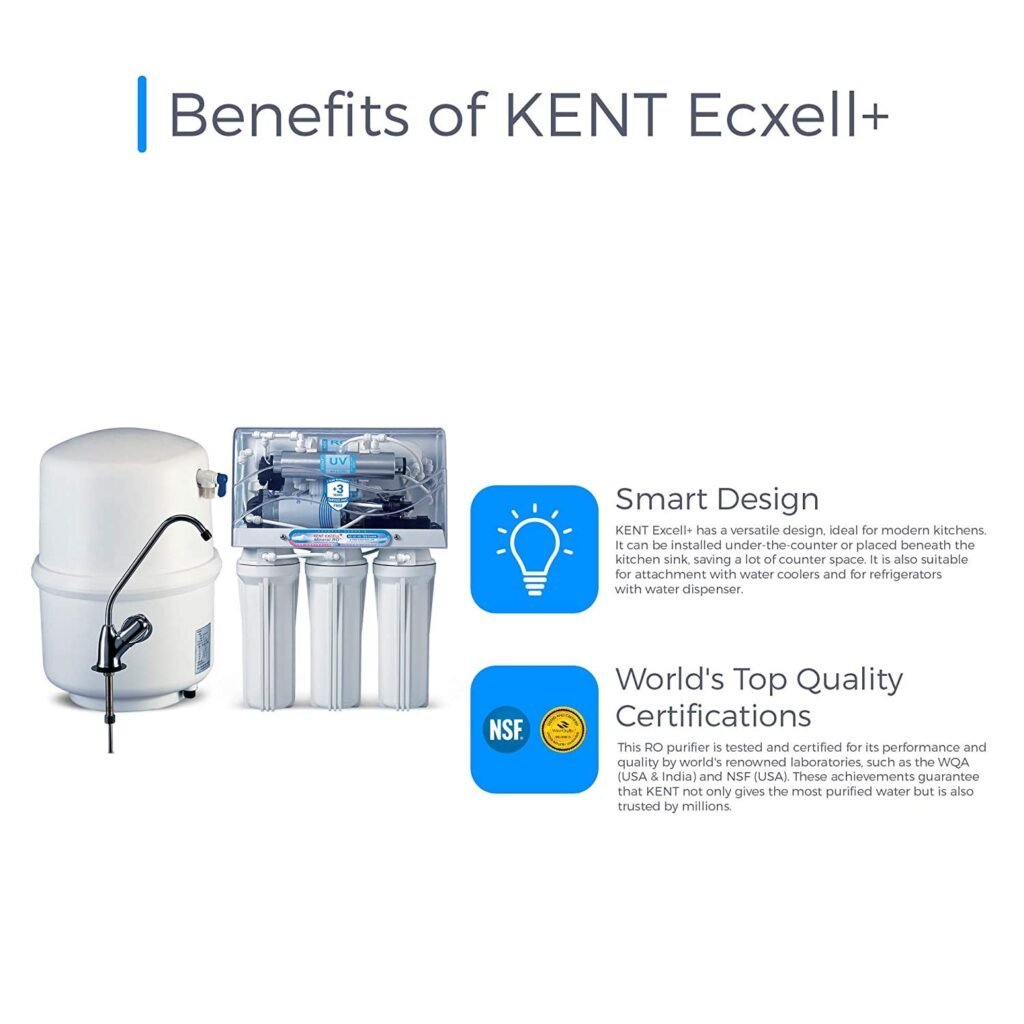
Our Kent RO water purification systems uses UV sterilisation along with RO, UF & Carbon filters.
Ceramic Filters
Ceramic filter systems are mechanical and simple.
They have tiny pores that block:
- Sediment
- Bacteria
Benefits:
- No electricity
- Reusable
- Long lifespan
Limitations:
- Slow flow rate
- No chemical removal
- No virus protection
Ceramic filters are niche, but reliable.
Often used in emergency or low-infrastructure settings.
Comparison Table: Sediment vs UF vs Nano vs RO
Here’s a clean, side-by-side breakdown to make things easier.
| Feature / Filter Type | Sediment Filter | UF Membrane | Nano Membrane | RO Membrane |
|---|---|---|---|---|
| Typical Micron Size | 1–5 micron | ~0.01 micron | ~0.001 micron | ~0.0001 micron |
| Removes Sand & Rust | Yes | Yes | Yes | Yes |
| Removes Bacteria | No | Yes | Yes | Yes |
| Removes Viruses | No | No | Partial | Yes |
| Removes Heavy Metals | No | No | Partial | Yes |
| Removes Dissolved Salts | No | No | Partial | Yes |
| Retains Minerals | Yes | Yes | Yes | Varies from systems |
| Electricity Needed | No | No | No | Yes (Booster Pump) |
| Water Wastage | None | None | Low to None | High |
| Maintenance Level | Low | Low | Medium | High |
| Common Use in Singapore | Pre-filter | Homes | Homes & offices | Labs, medical, old plumbing |
Which Filter Is Best for You?
There’s no universal best filter.
Only the best fit.
Choose based on how you actually use water.
- Better taste only: Activated carbon
- Protect your system: Sediment filter
- Daily family use: UF or Nano membrane
- Maximum purification: RO
- Extra sterilisation: UV add-on
- No electricity setups: Ceramic
If you’re unsure, don’t guess.
We help customers every day to choose the right filter based on home size, usage, and water flow.
Browse options or talk to us at Aqua Kent Singapore.
Clean water should feel simple.
And now, it is.